
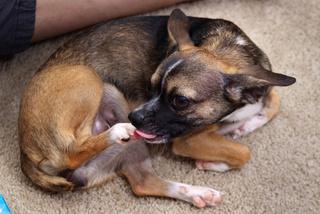
Your dog is outside happily nibbling on grass. Later, they spend several minutes licking the same paw. Then, just as guests arrive, they start scooting across the living room carpet.
Dogs can do some pretty curious things.
Sometimes, these behaviors are completely normal. Other times, they may be your dog’s way of letting you know that something doesn’t feel quite right. Since our four-legged family members can’t tell us exactly what is bothering them, paying attention to changes in their behavior can give us important clues.
Let’s take a closer look at three common dog behaviors and when they may be worth discussing with your veterinarian.
Behavior #1: Eating Grass
Let’s start with one of the most common questions pet parents ask: Why does my dog eat grass?
You may have heard that dogs eat grass because they are trying to make themselves vomit. While that can happen, it isn’t usually the reason.
Research suggests that fewer than 25% of dogs vomit after eating grass, and only about 10% appear sick beforehand. For many dogs, eating grass may simply be a normal behavior.
Some dogs may enjoy the taste or texture, while others may nibble grass when they are bored or exploring their environment.
So, if your dog occasionally snacks on a little grass during their morning walk or backyard patrol, it isn’t necessarily a reason to worry.
Quick Check: Is Your Dog’s Grass-Eating Habit Normal?
Ask yourself:
Are they casually eating a little grass and then continuing with their day?
This is usually not a cause for concern.
Are they frantically eating grass, drooling, repeatedly swallowing, or gulping air?
These behaviors may be associated with nausea or stomach discomfort and are worth discussing with your veterinarian.
Has the grass eating suddenly increased or is it happening along with vomiting, diarrhea, loss of appetite, or changes in energy?
It’s time to give us a call.
One more thing Florida pet parents should keep in mind: while grass itself is usually not harmful, fertilizers, pesticides, herbicides, and other lawn treatments can be.
If a lawn has recently been treated, keep your pet away from the area until it is considered safe according to the product instructions.
Behavior #2: Licking Their Paws
A little paw cleaning after a walk can be perfectly normal grooming.
But if your dog keeps licking or chewing the same paw, especially repeatedly or for long periods of time, something may be making them uncomfortable.
Paw licking is something we commonly see in dogs, and allergies are one possible cause.
Here in Florida, environmental allergens such as pollen, mold, and grasses can be a concern for much of the year. When allergens irritate the skin, dogs may feel that discomfort in their paws.
Licking may temporarily soothe the itch, but repeated licking also adds moisture to the area. That moisture can contribute to irritation and may create an environment where yeast or bacteria can thrive.
And allergies aren’t the only possibility.
Other Causes of Paw Licking
Something may be stuck.
A burr, splinter, torn nail, small cut, or irritation between the toes can lead to licking.
Something may hurt.
Dogs sometimes lick an area that is painful. If your dog consistently focuses on the same leg or paw, an injury or joint discomfort may be involved.
Boredom or anxiety may play a role.
Some dogs develop repetitive licking habits when they are bored, anxious, or looking for a way to self-soothe.
Quick Check: How Concerned Should You Be?
Occasional licking after a walk with paws that look healthy:
Usually not a concern.
Frequent licking or pinkish-brown saliva staining on the fur:
Consider scheduling a visit. Saliva staining can be a sign that your dog has been licking repeatedly.
Redness, swelling, odor, bleeding, sores, or limping:
Please give us a call promptly. These signs may indicate an infection, injury, or another condition that needs treatment.
One simple habit may also help pets with environmental sensitivities: gently wiping or rinsing their paws after outdoor time can help remove pollen, grass, and other debris before your dog settles back inside.
Behavior #3: Scooting
Ah, yes. The infamous carpet scoot.
It may be a little embarrassing when company is over, but for your dog, scooting usually means something around their rear end feels itchy, irritated, or uncomfortable.
One of the most common causes is trouble with the anal sacs, often called anal glands.
Dogs have two small anal sacs located near the anus. These sacs normally release fluid during bowel movements. Sometimes, however, they don’t empty properly.
When this happens, the sacs can become full or impacted, causing discomfort. In some cases, they can also become inflamed or infected.
Scooting may be your dog’s attempt to relieve that irritation.
Other Possible Causes of Scooting
Intestinal parasites
Tapeworm segments, for example, may sometimes look like small grains of rice around your dog’s rear end or bedding.
Something left behind after a bathroom trip
This can be especially common in dogs with longer or fluffier coats.
Allergies
Skin allergies can also cause itching around the rear end.
Diarrhea or soft stool
Changes in stool can irritate the area and may also affect how naturally the anal sacs empty.
Quick Check: One Scoot or a Pattern?
A single scoot may simply mean your dog had a little irritation after going to the bathroom.
However, repeated scooting, excessive licking around the rear end, a strong fishy odor, swelling, discomfort, blood, or discharge should be checked by your veterinary team.
And while you may find plenty of videos online showing how to express anal glands at home, it’s best not to attempt it unless your veterinarian has specifically shown you how and determined that your dog needs it.
Improper technique can cause unnecessary pain or injury, and repeated scooting may sometimes be caused by something other than full anal glands.
A veterinary exam allows us to identify what’s actually causing the discomfort and recommend the appropriate care.
The Pattern Behind All Three
There’s an important connection between grass eating, paw licking, and scooting.
Any of these behaviors can happen occasionally in a healthy dog.
What matters most is when the behavior becomes frequent, intense, persistent, or noticeably different from your pet’s normal routine.
You know your dog better than anyone. When one of their little quirks suddenly becomes a regular habit, that’s worth paying attention to.
Scripture reminds us:
“The righteous care for the needs of their animals.”
Proverbs 12:10, NIV
Caring for our pets often means noticing the little things.
Your dog may not be able to tell you exactly where they itch or what feels uncomfortable, but their behavior can help point us in the right direction.
When in Doubt, Ask Us
If your dog’s grass eating, paw licking, or scooting has you wondering whether something is wrong, we’re here to help.
At Kingdom Pet Hospital, we believe every pet deserves compassionate, personalized care and every pet parent deserves to feel heard and supported.
We proudly serve Riverview, Gibsonton, and the surrounding communities with comprehensive veterinary care. And when getting your pet to the hospital isn’t easy, we also offer convenient house calls.
Call us at (813) 538-1740 or book an appointment online.
Together, we’ll help figure out what your four-legged family member is trying to tell you.
Love Beyond the Leash.


